
You’re in a meeting. A colleague is tense. They’re irritated by a project that’s not going smoothly. It’s not your problem. And yet, you feel tense too. Your heart rate goes up. You feel the urge to do something.
Not because you’re directly involved, but because you’ve picked up on their tension — through facial expressions, tone of voice, body language. Emotional contagion happens fast, and mostly unconsciously.
How you respond in situations like this is often guided by an old script:
What used to work when someone around you was irritated?
Maybe what worked back then was that you:
- Played the joker. You tried to lighten the atmosphere. If you could make them laugh, things would settle down.
- Kept your head down and let it blow over. You stayed quiet, kept your head down, and waited for it to blow over.
- Solved problems. You learned that if you solved the other person’s issue, they would calm down — and so would you.
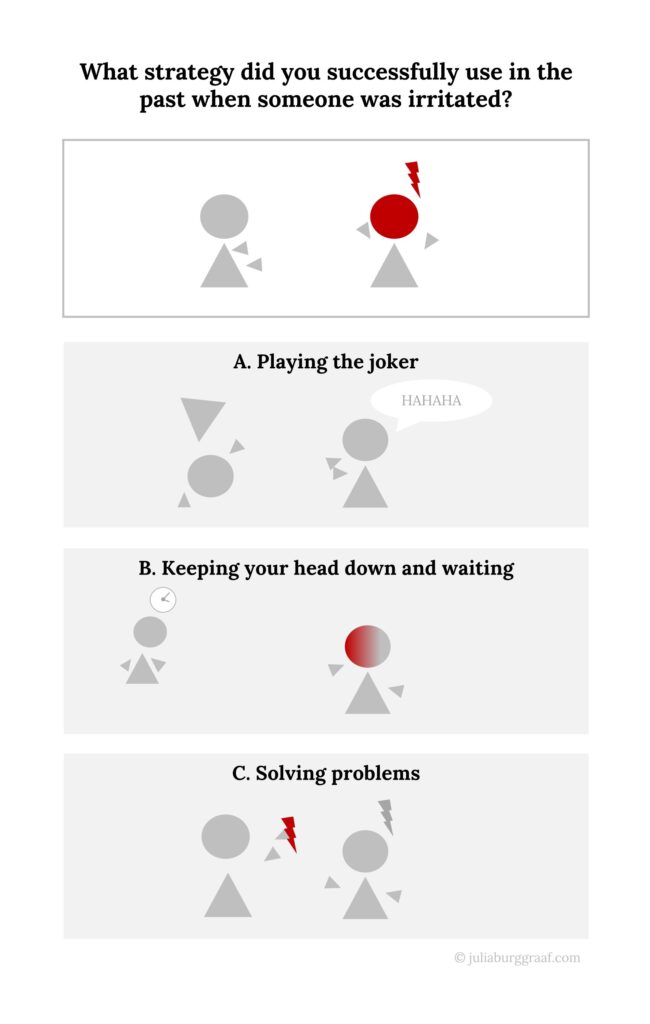
The strategy that worked best for you in the past was your superpower. And it still often works. Sometimes it’s even the very best thing you can do.
But not always.
Sometimes, afterwards, you regret that well-meant joke that didn’t ease the tension.
Sometimes you regret taking on someone else’s problem.
Sometimes you regret staying silent.
That old script often kicks in automatically — especially in moments of tension.
Want to choose your response more consciously?
Then it helps to take a short step back.
Grab a drink. Go to the restroom. Walk up and down the stairs.
Physically stepping away from the situation makes a difference. When you’re no longer sitting directly across from the other person, you’re less likely to absorb their emotions.
It becomes easier to ask yourself:
Do I want to do what I usually do? Or do you want to do something else?
Conclusion
The ‘old’ scripts we learned early in life can be incredibly helpful. But they can also be a hindrance.
Thankfully, it’s possible to learn to respond differently.
It’s not always easy — but you can make it easier for yourself by first taking a moment to settle before you respond.
That gives you more room to act from the version of yourself you are now — or the one you want to be.
And you can make a conscious choice: do I want to deviate from my usual script, or do I want to use it.
#psychology #communication #emotionalcontagion #behaviorchange #personaldevelopment